A crowd the size of Rome
💡 by user: prsca · 🤖 Built & fact-checked by AI · ✅ Human approved
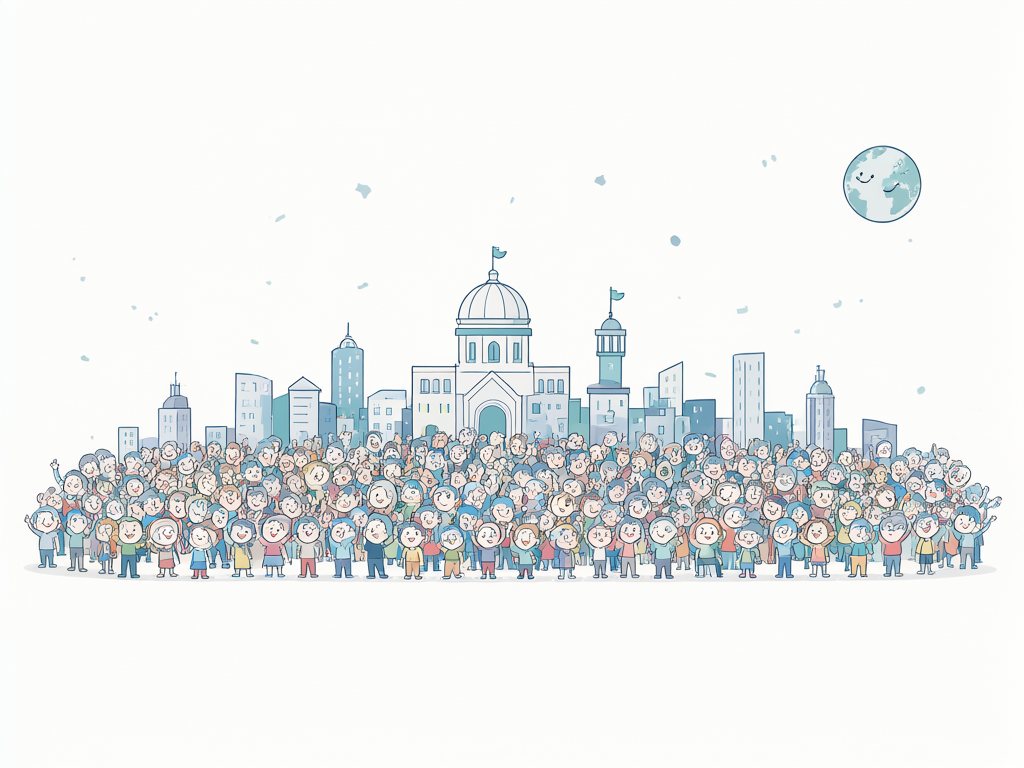
Every human alive right now — about 8.3 billion of us — is spread across farms, megacities, highways and deserts. Now fold the whole species into a single crowd, packed elbow to elbow, and ask the honest question: how much ground would humanity actually take up?
The question — as asked by prsca
If everyone on Earth stood shoulder to shoulder, how much land would we occupy?
In the proposer’s own words (untouched) — prsca
se tutti gli abitanti della Terra fossero gomito a gomito, che superficie occuperebbero?
One UN number and one personal-space number: 8.3 billion people, and roughly 0.15 m² each when packed tight (about 6–7 people per square metre). Multiply, then divide by a million — and recognise the result.
Work it out
- World population today: ≈ 8.3 billion people (UN estimates, live clock).
- Elbow to elbow, one person claims about 0.15 m² — roughly 6.7 people crammed onto one floor tile.
- 8.3 × 10⁹ × 0.15 m² ≈ 1.25 billion m² = about 1,245 km².
- The comune of Rome covers 1,285 km². Every human on Earth, standing packed, fits inside Rome — with a bus lane to spare.
- Bonus, one full square metre each (a small luxury): 8,300 km² — still smaller than Cyprus (9,251 km²).
One city the size of Rome — about 1,250 km² — would physically hold all 8.3 billion of us standing close. The planet isn't short of space; it's short of livable arrangements.
What it teaches
Population panic is counted in billions and feels unstoppable; the same number, spoken in square kilometres, fits inside one famous city. Units are an argument — change them and the panic changes size. Check the area before you call a number 'too many'.
💡 Hermi's tip — make it yours
Mark 1.5 m × 1.5 m on the floor and fit your family in it — the 0.15 m² assumption stops being abstract. Then check: at one person per square metre, which city actually contains humanity?
✍️ From a reader’s idea
se tutti gli abitanti della Terra fossero gomito a gomito, che superficie occuperebbero?
Verified numbers behind it
- World population: 8.33 billion (live UN clock, Nov 2026) — UN World Population Prospects via Worldometer ↗
- Elbow-to-elbow standing space: ~0.15 m² per person (≈ 6.7 people/m²) — crowd-density studies ↗
- Rome comune area: 1,285 km² — Istat ↗
- Cyprus area: 9,251 km² — standard reference ↗
How this page was built
- math — every step verified in Python, no shortcuts
- data — population checked against the live UN clock the day it went live
- illustration — 1 ComfyUI generation, passed QA
- short video — 190 frames → 15.8 s, poster included
- idea → live page — about 30 minutes